
Sallman’s head of Abe
As a Covenant pastor for the past 45 years, I have enjoyed creatively introducing newcomers to our relatively small denomination. In my inquirers’ classes, I would take pride in sharing that one of the most well-known hymns (“How Great Thou Art”) was written by a Covenant pastor in Sweden. I would also describe well-known personalities who have Covenant church connections, including Dr. G. Timothy Johnson (the longtime medical editor for ABC News), Mike Holmgren (the beloved former coach of the Green Bay Packers and Seattle Seahawks) and even Tom Hanks (who attended First Covenant Church in Oakland, California during high school). I would also introduce those checking out our church to a famous image of Jesus painted by a lifelong Covenanter.
The late Warner Sallman (1892-1968) is best known for his “Head of Christ.” What began as a charcoal drawing, “The Son of Man,” for the cover of the Covenant Companion in 1924 led to a full-color oil painting in 1940. Over 500 million prints of Sallman’s “Head of Christ” have been printed to date. The recognizable face is thought to be among the most reproduced images in history.
Sallman, who was a lifelong member of the Evangelical Covenant Church, took classes at the Chicago Art Institute at night while serving as a protégé to renowned newspaper illustrator Walter Marshall Cluett.
Although Sallman claimed that the facial features of Jesus that defined his famous work came to him in a vision, his painting has been called into question in recent decades. Critics have claimed the artist’s image is too Scandinavian and lacks global appeal. All the same, the work of this 20th- century illustrator remains iconic. When one thinks of what the carpenter-turned-rabbi from Nazareth might have looked like, it is likely Sallman’s “Head of Christ” comes to mind.
Curiously, Sallman’s brother-in-law, Haddon Sundblom, also had the distinction of creating a timeless image that succeeded in defining the physical characteristics of a cultural icon. Sundblom, also a Midwest illustrator with Swedish and Finnish roots, created the Coca-Cola Santa Claus that is what most people think of when they imagine the North Pole’s most famous resident.
As churchgoing Baby Boomers of the fifties and sixties would likely recognize, Sallman was also known for his rendition of the popular image “Christ at Heart’s Door,” as well as “Christ in Gethsemane,” “The Lord is My Shepherd,” and “Christ Our Pilot.” But Sallman did not exclusively have biblical themes for his easel.
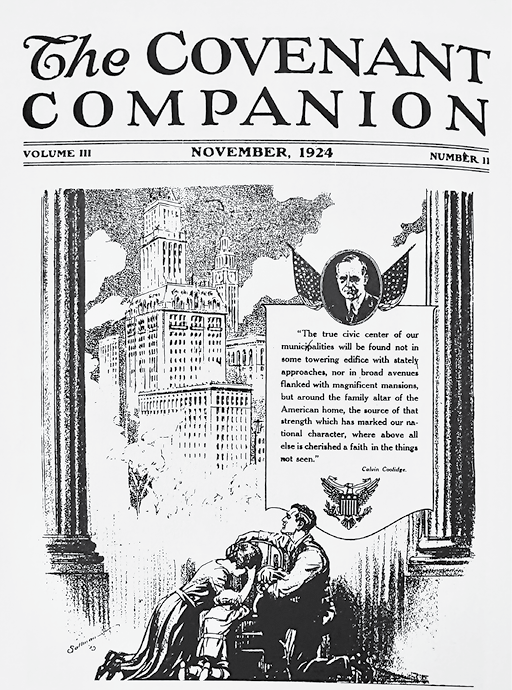
As a proud American, Sallman wanted to express his patriotism as well. For Sallman, the moral strength of America was not divorced from faith. On the cover of the Covenant Companion (November 1924) Sallman offered a pen and ink drawing of a family at prayer with the skyline of the city in the background. In the upper right hand corner of the cover is a sketch of President Calvin Coolidge with a quote attributed to him.
“The true civic center of our municipalities will not be found in some towering edifice with stately approaches nor in broad avenues flanked with magnificent mansions, but around the family altar of the American home, the source of that strength which has marked our national character, where above all else is cherished a faith in the things not seen.”
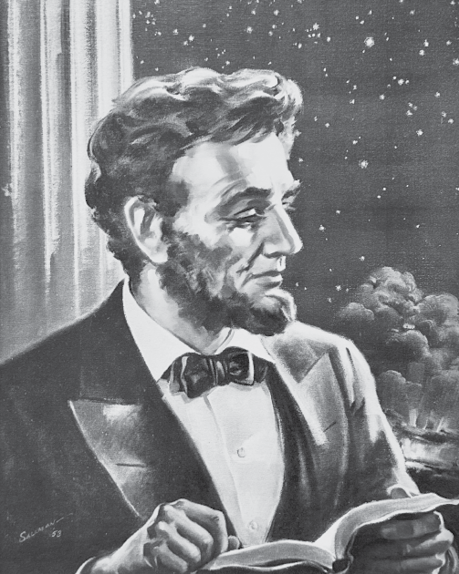
In 1958 the artist painted Abraham Lincoln holding an open Bible while images of the Civil War rage in the background. The painting was done in anticipation of the 150th anniversary of Lincoln’s birth that would be observed in February of 1959. Sallman’s homage to our nation’s 16th President’s acknowledgement of Divine Providence. Lincoln was the only President Sallman is known to have painted. Because he lived his entire life in Illinois, “The Land of Lincoln,” a case could be made that he was motivated by his knowledge of the prairie lawyer who became president.
As someone who raised three daughters in Illinois, my childhood appreciation of Lincoln only grew by increased exposure to the one I consider our greatest president. I’ve repeatedly visited Lincoln’s home and his law offices in Springfield, Illinois. Although some debate whether or not he claimed a personal relationship with Christ, Lincoln’s faith in God is without question. His dependence on the Almighty is seen in his Thanksgiving Declaration of 1863. Such dependence was undoubtedly a source of hope in Lincoln’s periodic battles with depression.
According to biographer Jack Lundbom (“Master Painter: Warner E. Sallman,” 1999), the inspiration for the artist to paint Lincoln came from an awareness of the following quote attributed to the president: “I am now profitably engaged in reading the Bible.” Sallman noted that after a long search to authenticate the statement, he was helped by the librarian at the Chicago Historical Society, locating the quote in the book “The Soul of Abraham Lincoln” by William E. Barton (1920).
“Joshua F. Speed, a long-time friend and confidant of Lincoln, one who had free access to the executive mansion at any time, relates the following experience in one of his lectures on Abraham Lincoln. It happened during the summer of 1864, several months before Lincoln was assassinated: ‘As I entered the room, near night, he was sitting near a window intently reading the Bible. Approaching him. I said, ‘I am glad to see you so profitably engaged!’ ‘Yes,’ he said, ‘I am profitably engaged.’ ‘Well,’ said I, ‘if you have recovered from your skepticism, I am sorry to say I have not.’ Looking me earnestly in the face, and placing his hand on my shoulder, he said, ‘You are wrong, Speed; take all of this Book upon reason that you can and the balance on faith and you will live and die a happier man’ (97-98).”
In September of 1963, just two months before President Kennedy was assassinated, Sallman painted another version of President Lincoln. In this watercolor Lincoln is pictured seated at a table reading an open Bible with his young son looking on. A quotation accompanying the painting reads, “Good boys who to their books apply will all be great men by and by.” It is likely that Sallman was thinking of Lincoln’s own boyhood when he taught himself to read the Bible, Aesop’s Fables, “Robinson Crusoe,” and Shakespeare by candlelight.
Some, rightfully concerned about trends toward Christian Nationalism, may take exception with Sallman’s inclusion of an open Bible in Lincoln’s hands. I look at it another way. Lincoln clutching his Bible is an indication of the ongoing need to ground our national identity on our Judeo-Christian heritage. Like Bishop Mariann Budde shared in her homily on Matthew 7:24-29 at the recent Inauguration prayer service at the National Cathedral, our nation is best served by building on the foundation of biblical truths, namely finding unity by honoring the inherent dignity of every human being, by our honesty, and by our humility.
“I am a person of faith, and with God’s help I believe that unity in this country is possible—not perfectly, for we are imperfect people and an imperfect union—but sufficient enough to keep us believing in and working to realize the ideals of the United States of America—ideals expressed in the Declaration of Independence, with its assertion of innate human equality and dignity.”
That call to justice, integrity, honesty, and compassion is needed now more than ever.