
Danish pastry (Wienerbrød)
Danish pastry, a much-loved delicacy around the globe, suffers from an identity crisis like no other baked good. A bit of history tells us why. In the mid 1800s, Copenhagen bakers went on strike and were temporarily replaced by bakers from Vienna. The Austrians brought their technique of laminating butter between layers of dough to Copenhagen and people loved it. When the Danish bakers returned to work, they incorporated the Viennese methods with their own variation which was richer and sweeter. Ironically, what is called Danish pastry, or “Danish” outside of Scandinavia, is known in Denmark as wienerbrød, which directly translated means “Viennese bread.” Sometimes it is also called kringle, which means round, though sometimes it is shaped like a giant pretzel.
This second name, kringle, adds more confusion. I have heard people erroneously call another pastry kringle which is actually almond flavored choux pastry (French, pâte à choux). While to some it may resemble wienerbrød in looks, it is completely different. Choux pastry is made of flour, water, milk, butter, salt, and eggs. In baking this moist dough, steam is the leaven for creating eclairs and cream puffs. Obviously, this is nothing like wienerbrød, which requires butter layered between thin sheets of yeast dough. While there’s nothing wrong with choux pastry, let’s not confuse it with wienerbrød.
I am terribly fond of wienerbrød, partly because it harkens back to wonderful occasions when my Danish-born Grandma Anna came to our house with bulging packages wrapped in white bakery paper tied up with red and white string. I’d wait in great anticipation to see what filling she’d chosen for this immense oval pastry. Was it apple, almond, or cinnamon pecan? I loved them all and was amazed by her perfectly drizzled icing that zig-zagged back and forth across the top.
Perhaps it doesn’t matter what a pastry is called, but then again, identity is important. As a child, I suffered a minor crisis of identity growing up in a church that celebrated Sankta Lucia. I wondered if I fully belonged because my father was from Denmark, that small country southwest of Sweden with an “unpronounceable” language. Now that I live in Sweden, where the young woman chosen to represent the (Sicilian) Saint Lucia might as well come from Tehran as from Stockholm, I realize how ridiculous it was for me to feel inferior because I was only 50 percent Swedish!
Thankfully, what I did take home from church and from many experiences in Christian community since, is that we are invited to embrace our identity in Christ. “See what great love the Father has lavished on us, that we should be called children of God! And that is what we are” (1 John 3:1). To be a child of God is the foundation of our being. This strong sense of knowing who we are in relation to our Creator, sets us firmly in a place of belonging.
My husband, Eric and I have the privilege of welcoming many international university students to Lund, Sweden, where creating a place for belonging is important. As our students come from all corners of the world, we invite them into a space where they find connection, feel heard, and are not judged. We delight in seeing friendships grow and faith taking root. Knowing who we are as children of God, is what we long to share. The beauty of international students is their openness to the message that their identity isn’t in what the world tries to impress upon us, but on the fact that God loves us and calls us his children.
Last year the words of a wise Chinese-born woman in our group inspired me to continue welcoming those who haven’t yet experienced Christ. She thoughtfully said, “I don’t necessarily believe everything you teach about Jesus, but I know that I belong.” Recently, just one year later, I heard her say, “I never thought I would attend a Christian group, but now I realize I’m in pretty deep.” It’s in the belonging where seeds of faith are planted. As others join the fellowship, we hope they too will know for certain that their true identity is in being a dearly loved child of God.
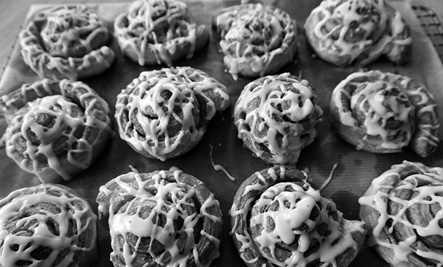
Cook’s Note: It is easier to make wienerbrød than you may think. The dough is very forgiving. Read the entire recipe before you begin. Dough that is layered and well wrapped keeps in the refrigerator for up to two days before baking. If the butter gets too soft at any time during the rolling process, place it in the refrigerator until it firms up.
It’s best to store the baked pastry in an airtight container at room temperature for up to two days. If you need to hold it longer, it freezes beautifully without icing. Warm it in the oven and drizzle icing over the top before serving.
Wienerbrød can be made in additional shapes and with other fillings. These are just two classics that we like best.
Wienerbrød
Dough:
3½ cups all-purpose flour (438g)
3 T. sugar (34g)
1 tsp. salt
1 tsp. freshly ground cardamom (optional)
1 cup cold milk, scant
1 oz. fresh yeast (28g), or 14g active dry yeast
2 eggs
1 cup unsalted butter, cold (226g)
In a large mixing bowl, whisk together flour, sugar, salt and cardamom. In a second smaller bowl stir together milk and yeast. When yeast is dissolved, stir in eggs.
Pour milk, egg, yeast mixture into dry ingredients. Combine using a plastic bowl scraper. Work dough in bowl until it clings together in a uniform mass. It will be sticky. Scrape dough onto a well-floured board or work surface. Using a bench scraper and well-floured hands, knead dough for up to five minutes. If it is too hard to handle, invert a bowl over the dough and let it rest. It will be easier to handle after about 30 minutes. While dough rests, slice butter into thin slices, about 1/8 inch thick.
Using a bench scraper, pull dough together into a loose ball. Add more flour to work surface. With a floured rolling pin, gently roll dough to a rectangle 12x16 inches. Place butter slices touching, or almost touching each other over 2/3 of the dough. Fold dough like a letter, with the third that has no butter first over half of the part with butter. Next pull the final buttered layer over the top enclosing the butter completely. Pinch edges closed. Keeping a light layer of flour on the board and on the rolling pin, roll the dough again to 12x16 inches. Fold into thirds like a letter for a second time.
Wrap dough in plastic wrap and refrigerate for a couple hours or overnight. After chilling, roll dough onto a large rectangle and fold into thirds two more times. This creates 81 layers.
Finally, roll dough the final time to a rectangle about 13x18 inches. To make 12-14 cinnamon snegle (“snails,” a Copenhagen classic), and an almond-filled kringle, or ring, cut dough into half. Place half in the refrigerator.
Cinnamon Snegle
Filling:
4 T. soft butter (56g)
2 T. granulated sugar
2 T. brown sugar
1 ½ tsp. cinnamon
pinch salt
Stir filling ingredients together to make a smooth paste. On a lightly floured board, roll half of the dough into a rectangle about 9x12 inches. Spread cinnamon filling over the dough. Roll it up like a jellyroll and slice into 12-14 pinwheels. Place rolls on parchment lined baking sheet. Allow pastry to rise in a cool place for 30-45 minutes. Bake at 425 degrees for 12-14 minutes or until deep golden brown. Some butter will leach from pastry as it bakes. Cool on brown paper bag.
Almond Kringle
Filling:
3 oz. almond paste, grated (85g)
3 T. soft butter (42g)
3 T sugar (34g)
¼ tsp. almond extract
Stir filling ingredients together making a smooth paste. Using a floured rolling pin on a floured work surface, roll remaining half of dough into a rectangle 9x12 inches. Roll up jellyroll style. Place on a parchment lined baking sheet connecting the ends to form a complete circle. Using a scissor, make 1½ inch snips in the top of the kringle every inch or so all the way around. Allow pastry to rise in a cool place for 45 minutes. Bake at 425 degrees for 5 minutes. Reduce heat to 400 degrees and continue baking for 12-14 minutes. If the top is browning too quickly, tent with aluminum foil. Slide kringle on its parchment to a cooling rack.
Icing
1½ cups confectioners’ sugar
1 T. whole milk
¼ tsp vanilla extract
Stir together adding milk as necessary to create a consistency that drizzles easily. Ice the snegle. Add ¼ tsp. almond extract to remaining icing. Adjust consistency and drizzle icing in back and forth motion over kringle.