
A Christmas Wish for Little Dala Horse
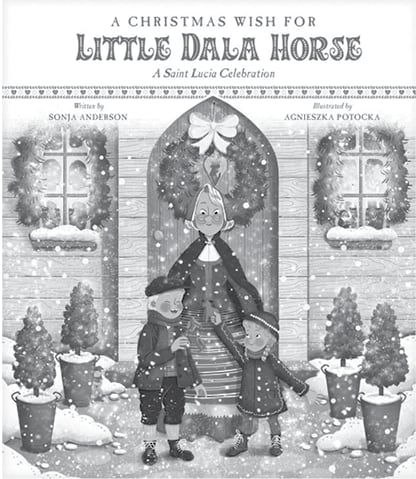
A Christmas Wish for Little Dala Horse: A Saint Lucia Celebration
By Sonja Anderson
Illustrations by Agnieszka Potocka
Tyndale House, 2025, 32 pages
I grew up in a family with Swedish and Norwegian roots and am the great-granddaughter of immigrants and the granddaughter of those who were born in America but spoke Swedish as their first language. My parents were steeped in the lore and traditions of their own family stories, and they transmitted this cultural heritage to their children through the names they gave us, the family relationships they nurtured, and the traditions we embraced. This occurred alongside a robust faith and participation in the life of the church.
As for many Scandinavian-American families, Advent and Christmastime have always been some of the most sacred — and Scandinavian — times of the year. Dala horses and Carl Larsson paintings were on display all year long, but Christmas was when the special candelabras, the straw ornaments, and the julbock (Christmas goat) came out. We listened to “Evie” (Evelyn Tornquist Karlsson) sing Swedish and English versions of her Christmas album, baked cookies like pepparkakor, krumkakor, spritz, and brunekakor, and learned how to weave Swedish paper hearts. We celebrated Lucia morning in our home, albeit with Pillsbury cinnamon rolls. We had our smörgåsbord on Christmas Eve, while most families around us saved their big celebration for Christmas Day. I adored the angel chime candles that provided light and music for our Christmas Eve dessert of cookies and candy before bedtime. A big part of the reason I attended North Park University and participated in the Swedish exchange program at Södra Vätterbygdens Folkhögskola in Jönköping was because of this inherited and imbibed sense of cultural identity. I wanted to learn more about my heritage, meet relatives, and more fully understand the culture and language that had shaped my family’s origins.
There are pockets of Swedish Christmas all over the United States, including at First Covenant Church in Seattle where author Sonja Anderson raised her family, and they are special sources of light, hope, and joy in this season for all who find them, Scandinavian or otherwise. All families who celebrate Christmas and appreciate learning about world cultures and traditions can enjoy reading and perusing Anderson’s new book, “A Christmas Wish for Little Dala Horse: A Saint Lucia Celebration.” It is born out of, and is written in service of, the same sorts of formative experiences that I enjoyed as a child. This book would be a wonderful way to familiarize children with some special aspects of Swedish culture. Anderson gives a heartwarming testimony as to how special it was for her to belong to First Covenant and participate in their annual Julfest while her daughters were growing up. For those not familiar with Swedish Christmas traditions, this book would be a good introduction.
The story is told from the perspective of a Dala horse, newly carved and freshly painted with his base coat of red-orange, as he experiences his first Christmas season. The questions and wishes of Little Dala, including learning what it means to love and be loved, are fulfilled as he witnesses a Lucia procession through the window and stows away to surreptitiously attend a Christmas service in a little boy’s pocket. Old Dala, a beloved family heirloom, serves as his mentor and guide in the beginning of the story, explaining his own origins in the family and telling Little Dala about Christmas traditions. The book includes background information about Saint Lucia in an afterword. However, the Lucia celebration in the book functions mostly as a part of the setting; the plot is not so much about Lucia as it is about Little Dala’s ruminations on Christmas celebrations and the emotional and relational needs of the children in the story. Little Dala decides to act with bravery born out of love in order to help a new friend, inspired by the example of Lucia. The author does a lovely job of weaving together several traditions into one narrative.
This book is probably best suited for children from 3 to 10 years old, though older children would enjoy reading it to younger friends or family members. There are a couple of unique features that make the text and the illustrations extra engaging: Swedish words are sprinkled throughout the story, along with translations, and there are also tomtar (Christmas gnomes) who can be found peeking out of the background illustrations on most pages in a seek-and-find style. It would be nice to have phonetic pronunciations for the Swedish vocabulary, either in the sidebars where they are featured or in a vocabulary list in the back of the book, since some pronunciations are not intuitive for speakers of other languages. The care and delight of its author and illustrator are evident on each page, and the illustrations are both folksy and whimsical at the same time. This book would be a nice addition to any family’s holiday library if they have young children. God jul!