
Wilderness and faith
This sermon was preached for Augustana College’s J-Term “Wilderness and Faith” class, held at Covenant Point in Upper Michigan in January 2025.
Jesus, full of the Holy Spirit, left the Jordan and was led by the Spirit into the wilderness, where for 40 days he was tempted by the devil. He ate nothing during those days, and at the end of them he was hungry.
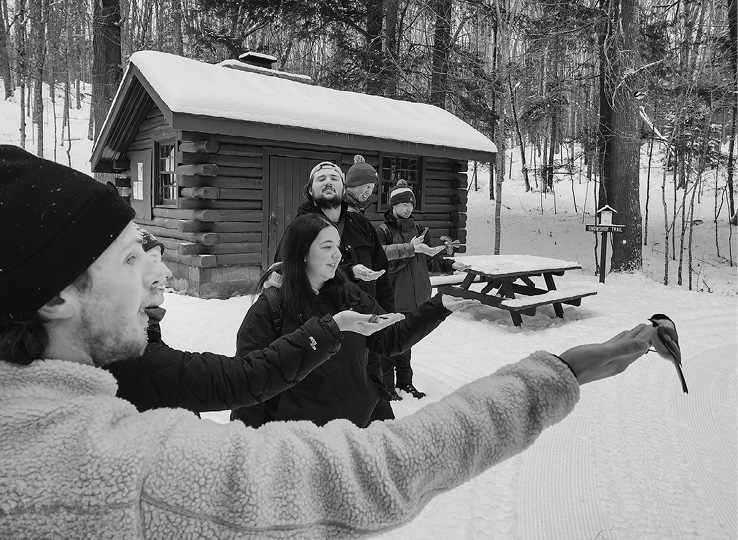
Feeding Chickadees near Anvil Lake, Wisconsin. Photo: Mark Safstrom
Welcome and Congratulations! You are on your final leg of your journey into the northern wilds of the Upper Peninsula. Like Jesus, you all have been led by the Holy Spirit into this wilderness, whether you know it, or not! I don’t need to know anything about anyone’s faith walk to believe that the Spirit led you here.
So how has your wilderness experience been? In what ways have you experienced it? An icy plunge into the waters of Hagerman Lake? Feeding chickadees that softly alit on your bare hand in the middle of nowhere on a remote trail? Walking on ice on a frost-bitten walk to the Island? Maybe sitting in the dining hall in front of a warm fire and contemplating the comfort, grace, and love of God in this winter camp with the Augustana community? Wherever your days have taken you, I hope you’ve experienced faith—the presence of God—in what can be a less than hospitable season of cold and darkness and isolation.
Jesus too experienced wilderness—I’m speaking of the harsh realities of wilderness—when he was led by the Spirit to the desert only to be tempted relentlessly for 40 days. We may think of it as not being so big a deal for him because he was with God, and he was God. Jesus had to feel enormous discomfort to be in the presence of the devil—which represents to me everything God isn’t—for 40 days. “Wilderness,” for us, is a rich metaphor for so many things—loneliness, hunger, uncertainties, sadness, shame, discouragement, temptations, riskiness, fear. But these conditions, these wilderness experiences, are an inescapable part of life. Whether they are 40 days or 40 years or a J-Term. Wild places teach us what it means to be human. Being in the wilderness allows us time to find out what faith means, out beyond the boundaries of where we never thought we’d ever want to go. But here you are!
Sometimes while in the dark night of the soul, such as where Jesus found himself in the desert, there are simply no words to cover the depths of your experience of sorrow and grief. One of the Hebrew words for wilderness in scripture literally means “the wordless place.” Doesn’t that resonate with our experiences of grief? Trials can be wordless. Wilderness makes us consider the deeper and larger reality of our existence. Faith is what saves us in the wilderness. Sometimes, that can be incredibly hard to believe, but we just need to trust in that.
In a real wilderness, when we face temptations and trials—things can shatter what we know about ourselves; the uncertainties, the waiting, the pain, the fear, the realization that this is how bad things can get and I am totally not in control. There’s something about the desperation that kicks faith into high gear. As writer Barbara Brown Taylor put it, things like “the death of your identity, the death of your certainty, your old community, your life as you know it. Those deaths are all entirely possible. They’re all in mortal danger.” She goes on to mention a few examples of what is meant by “wilderness,” including a dying church and addiction: “Losing too many friends all at once, especially when they are young, is a wilderness. Aging is a wilderness. Deep love for this suffering planet is a wilderness. Basically, anything that shows you how breakable you are, how breakable everything is, constitutes a wilderness.”1
I don’t know what your wilderness is all about, but each of you do, and you’re the only ones who can decide whether God is in it or not. By the grace of God, the loving presence of God is always available to spiritual seekers. As Brown says, it is like a “wilderness protection program, open to anyone willing to leave the pavement and be emptied right out, making room for God-knows-what is coming next.”
So how have you experienced faith these past few weeks? Maybe you felt God’s incarnational presence while descending that ladder into the numbing waters, your skin signaling to stop-this-right-now—the sensation of being pricked by a thousand pins and needles—as you stood there, feet planted on squishy sand looking at the world from the vantage point of an otter. Feeling strangely odd but truly mentally alert and physically alive. Maybe in feeding the wild birds, you felt humbled, true humility, when that chickadee gently scratched the surface of your palm to pick up that one tiny sunflower seed. Or maybe you felt what it means to follow Jesus, to walk on water like he did, on that journey out to the Island, trusting that the ice would hold you, sustain you, and keep you from falling through the dangerous hidden cracks of life. Like the frozen water, Jesus holds us, sustains us, and keeps us in loving faith. Jesus never lets go.
This is the invitation for each of you to consider, what does this wilderness experience mean for you? This camp has been for decades a wonderful place for spiritual breakthrough, new insights, and discernment. What gets spoken and written onto our hearts may not come in the form of words as we know them but rather in contemplations, musings, and visual memories in the weeks ahead. When you get back to the real world of classroom and schedules, conflicts and dilemmas, reflect back on the quiet stillness of wilderness that you found here. Take it with you. God’s presence in it all. For you to decide what it all means. For you to follow it into Spring. Amen.
1. On the podcast Evolving Faith, “A Subsistence Spirituality,” May 2022.