
A traumatic uprooting
“And if the church becomes an instrument of further fragmentation, then the church had better ask itself whether or not it is being faithful to the possibilities inherent in the good news to make people whole.”
~ Zenos Hawkinson, Anatomy of the Pilgrim Experience
This June marked six years since First Covenant Church of Minneapolis was expelled from the Evangelical Covenant Church for their welcoming position on gay marriage in 2019. It is also two years since another Twin Cities church, Awaken Community, was expelled for the same reason. Those events were also the beginning of my exit from my own church of over 40 years, Excelsior Covenant. For myself and many Covenanters, the change of character in our denomination revealed by these events was a traumatic uprooting.
A turning point for me came after a congregational meeting at my church on June 2, 2019. It felt like an ambush. At the last minute, an “Update from the Northwest Conference” was added to the meeting agenda. I was a member of the leadership team, but we hadn’t been informed of this change. A large group of people, certain to vote against First Covenant, had apparently been encouraged to show up at the meeting. During this update, we were told that a “radical” group had taken control of First Covenant, determined to change the denomination’s stance on marriage. We were also told that all of the Covenant old-timers had left First Covenant. This news stirred up anger and outrage. A motion was made requiring our delegates to the Covenant annual meeting to vote for the expulsion of First Covenant Church. Some leapt out of their seats to second the motion. While it did not pass, many of us were left to wonder what had just happened. As I walked out of the church that day, I promised myself I need never return.
The motion was unnecessary; all four delegates from our congregation that year were among the more ardent supporters of traditional marriage. Our constitutional process had not been followed in selecting these delegates. At the time these delegates’ names were brought to the leadership team for approval, we did not know that the denomination’s annual meeting would decide whether to expel a church from our fellowship, despite the extensive planning by conference and denominational leadership to propose this extraordinary action. Like many churches across the Covenant, our delegates had already been appointed before we were told about the expulsion vote.
I heard similar stories from churches across the Northwest Conference. No time or guidance was given for local congregations to discuss the impact of expelling another congregation from the denomination. In some churches, the pastors decided to serve as delegates themselves, instead of members of the congregation. A family member was told by their interim pastor that he didn’t even consider First Covenant to be a Christian church. Conference leaders and pastors stacked annual meeting delegates to vote against First Covenant, often without congregational discussion or leadership team approval.
At my church, a sermon based in Acts, upholding the diverse early church united by Christ as a helpful model for us today, was removed from the church website ahead of the annual meeting. The sermon had been preached the Sunday after the difficult congregational meeting, drawing from Acts 4:32: “All the believers were one in heart and mind.” After the annual meeting, some expressed hope that all those Covenanters who had supported First Covenant Church would now leave the denomination. Others expressed hope that a “sister” denomination to the Covenant Church would be formed, so we would still support Covenant institutions. Though we were no longer wanted, our money apparently still was.
My family worshiped at First Covenant Church the Sunday following the vote. It felt like a reunion of “old-time” Covenanters. We reconnected with former teachers from Minnehaha Academy and North Park University, with Covenant pastors, and friends with whom I had served on North Park’s board of trustees. I met members of the current First Covenant leadership team who had belonged to the church for decades, as well as many generational Covenanters. It very much felt like a Covenant church, one faithfully sharing the good news of Jesus with its urban neighbors.
Many of us have experienced a seismic shift in our understanding of same-sex orientation. We no longer view this as a choice, but as an inborn part of a person’s identity. What we once thought of as a question of morality we now see also as a question of biology. Younger generations accept this as fact, and view same-sex orientation and inclusion as a civil rights issue. For many of us this change led us to question and reconsider traditional interpretations of certain biblical passages. We have reflected deeply on the words and actions of Jesus toward religious insiders and outsiders of his day. As Christ’s ambassadors in a fallen world, we feel a great responsibility to see and treat people as Jesus would.
Covenanters have gone through similar deliberations before, many of us in our own lifetime. Prior to the 1976 vote to ordain women, scripture was read by some in our denomination to exclude women from certain roles in church. But as our views on women’s roles expanded, our understanding of scripture was enriched. The Covenant now supports the gifts of women and their call to leadership in the church. This includes the Covenant’s first female president. Because we have changed our minds, we have become stronger. We can be thankful that previous generations didn’t use their power to institutionalize a traditional view of women in ministry. What would the denomination look like today if we had refused to change? We would, I believe, be a much diminished group, irrelevant to younger generations. This is now where the church risks finding itself.
In 1959, in similar denominational debates about Christian freedom, Herb Palmquist, a Covenant pastor and denominational vice president, wrote that “what the Covenant has seemed…to say is this: You have the right of private interpretation, but you do not have the right, because of your interpretation, to break the fellowship, for that is based on the blood of Christ. In the Christian church there is room for many opinions, but there is no room for division. You are free to believe what you think the Bible teaches, and you are free to seek to convince your brother, but you are not free to say that he is a lesser Christian because he has another understanding of the Scriptures that you do. You have the right to learn with us as we pursue this study together, but you do not have the right to sow mistrust of those who have come to another conclusion” (James Hawkinson, Glad Hearts, 72-73).
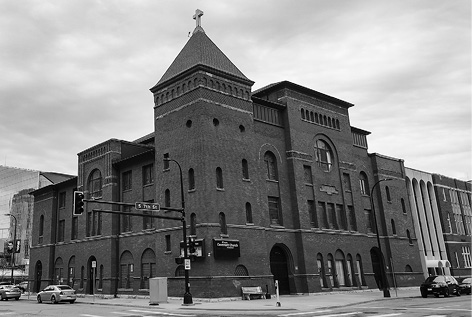
First Covenant Minneapolis, Photo: Mark Safstrom
My former church has experienced a rocky six years. Division and a large exodus over the First Covenant vote have resulted in a tug of war in other areas. Some members left the church following the death of George Floyd, concluding that our church’s position on race did not match theirs. Others left during the pandemic, in disagreement over the church’s decision to follow public health instructions. Fearing our church might take a position that is right or wrong, we get pulled into culture wars. No one wants to be labeled as unbiblical. Maneuvering for power and control is the result. Is it any wonder that many young people consider church involvement to be optional, or even harmful?
In his 1997 Covenant Companion article, “Yesterday’s Seed is Tomorrow’s Harvest,” Rev. Glenn Palmberg argued that the Covenant Church, by offering a home for believers of many perspectives, could face a threat: “The risk comes from the people who are welcomed through our doors but want to close the doors behind themselves, those who want to limit the participation or place of others because of a different theological perspective, worship style or gender. There is a sort of Catch-22 to Covenant freedom. Can you include the non-inclusive people? Can you accept people who will not accept others?” (Glad Hearts, 67). Our immigrant Covenant founders experienced and rejected life under a centralized state church that often placed correct belief over a living faith. So they joined together to build something different.
Reflecting on the past six years, I’ve come to the conclusion that the update given to our congregation by the Northwest Conference in 2019 did contain some truth. Those with a specific agenda to change or cement the denomination’s stance on marriage had taken control. The Covenant’s embrace of freedom in Christ was traded for a narrow interpretation of marriage. Tony Blair, former UK prime minister, argues that current societal debates have left behind the traditional right vs. left dichotomy, and replaced it with open vs. closed societies. Sadly, this also describes the change in character of our denomination, and more broadly, American Christianity.
To me, this goes against the grain of God’s work throughout history and the example of Jesus. Our Covenant Affirmations offer a third way to stay together through challenging times. These should have positioned our denomination to demonstrate unity in Christ in a broken world. The solution to the current toxic climate is to be a community of believers who hold a diversity of viewpoints in disputable matters, but are committed to a healthy dialog that respects listening, and remains open to change their minds. This is the church I believed I was already part of. So many of us who left our churches feel that we were forced out. This experience remains deeply painful, something I know many others wrestle with as well. In hindsight, has not our “old” Covenant way of being together increased immensely in value? Isn’t it worth trying to recover?