
Labor of love
Welcome to this 100th issue of Pietisten! On a milestone like this, we pause to celebrate the community of readers that this journal has made possible. As with each issue since 1986, our faithful staff of volunteers has sought to gather thought-provoking and uplifting articles, sermons, poetry, and artwork that emanate from our heritage in Pietism. More on that heritage and content below.
One hundred issues also corresponds with 15 years since the current staff assumed responsibility for this journal. We can’t believe time has gone by so quickly! Through 2009 the journal was published out of Minneapolis, with Phil Johnson as its steady editor. Gathering friends to write and discuss articles, edit together, and stuff mailing envelopes was Phil’s great work and spanned nearly a quarter century. Phil and Sandy Johnson’s home in the Minnehaha neighborhood became Pietisten’s “headquarters,” where the Johnsons would host countless festive editing parties over the years.
By the late 2000s, Phil was beginning to look for a “younger” group of editors who could take over this work. Such a team of editors was found, and in 2010 the center of activity shifted from Minneapolis to Seattle. At the time, most of this new team attended First Covenant Church in Seattle, with the addition of Rev. Mark E. Swanson, then pastoring the Wiley Heights Covenant Church in Yakima, Washington. The all-volunteer publications staff currently includes Karl Nelson and Sandy Nelson (both of Seattle), Stephanie Johnson Blomgren (Vashon, WA), Rev. Steve Elde (Edmonds, WA), David Nelson (Bremerton, WA), and Mark Safstrom and Rev. Ryan Eikenbary-Barber (Chicago).
Since 1986, the work of well over 300 authors has appeared in Pietisten. Deep thanks to all of you who have shared your perspectives, insights, and talents with us! (Most of these articles are available online, at pietisten.org/authors.)
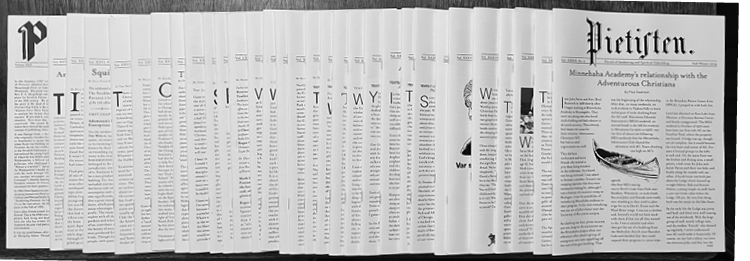
15 years of Pietisten issues produced by the Seattle team.
The scope of our journal has been ecumenical and we are interested in the broad heritage of Lutheran Pietism. We take seriously the watchword of the early Mission Friends, who were avid readers of Pietisten: “I am a companion of all who fear you” (Psalm 119:63). “Pietisten” means “The Pietist” in Swedish, and was the name of a devotional newspaper published between 1842 and 1917 by George Scott, Carl Olof Rosenius, and Paul Peter Waldenström—a Methodist, a Lutheran and a Covenanter, respectively. The legacy of their strand of Pietism can especially be seen in the history and current life of the Evangelical Covenant Church and the Mission Covenant Church of Sweden (Equmeniakyrkan), the Augustana Lutheran heritage (within the Evangelical Lutheran Church in America), the Evangelical Free Church, and the Baptist General Conference (Converge). Authors representing all these traditions have appeared regularly in our journal, and we want to renew the invitation for our diverse readership to continue to see Pietisten as a forum for discussing our common heritage and mission. Keep those submissions coming!
Our content has been eclectic by design, and includes some features of the original Pietisten, such as devotional reflections, Bible commentary, essays on church history, as well as much more. Reprinted sermons that have a literary, church-historical, or cultural dimension are often the featured articles. Examples of regular features include the church-historical essays of Tom Tredway; book reviews by Jay Phelan and others; philosophical musings by “Penrod,” Phil Johnson, and Elder Lindahl; Glen Wiberg’s and David Bjorlin’s “Sightings in Christian Music”; David Hawkinson’s Bible commentary; Bonnie Sparmann’s cooking column “Taste and See”; “Sports Prophecies” by Eric Johnson and Eric Nelson; and original poetry by Art Mampel and Ann Boaden. Artwork and layout design have been capably provided by Sandy Nelson. Our intent has been to “bless all forms of human endeavor and ministry” and to gather people in an inclusive fellowship of readers, whether they find themselves inside or alongside the church.
Pietisten has also been involved in several book publications over the years, including Glen Wiberg’s “Singing the Story” (2011) and my own translation of “Squire Adamsson” (2013), a religious allegory by Paul Peter Waldenström from the 1860s. In 2017, the group released a 75-minute historical documentary, “God’s Glory, Neighbor’s Good: The Story of Pietism,” written by Mark Safstrom and Michelle Clifton-Soderstrom, narrated by G. Timothy Johnson, and produced by Tim Frakes. The documentary was filmed on location in Germany and Scandinavia, and has appeared on public television in the Midwest several times. Donations by friends of Pietisten financed that documentary, for which we remain humbled and grateful!
The editors of Pietisten have occasionally hosted events for readers and friends of the magazine, including picnics, Christmas parties, and hymn sings. Pietisten authors have also taught adult Sunday school at churches around the country. If you would like a Pietisten editor to lead a Sunday school or event at your church, reach out to us and we will see what we can do!
Some of you may have received this issue as a gift from a friend or colleague. We hope you enjoy it and will become a member! This was part of a drive to reach 100 new members in honor of this milestone year. Welcome!
All this work has been a labor of love. I can say for myself that being part of this community has been a delight and blessing. Our masthead reads “herald of awakening and spiritual upbuilding” (andlig uppbyggelse), a nod to the original Pietisten’s self-description. It also echoes Søren Kierkegaard’s concept of “upbuilding” as found in 1 Corinthians 8, where St. Paul states that “knowledge puffs up, but love builds up.” In Danish, as with Swedish, the verb is “to upbuild” (opbygge), something Kierkegaard demonstrates playfully in his “Works of Love.” It remains our hope that this journal will continue to upbuild and awaken in that spirit.
While historical reflection is clearly an important aspect of Pietisten’s work, we also believe that this heritage has important things to say to our present and future. Pietism is something present in our lives and the way we approach the gospel. The past decade and a half has been marked by a rise of deconstructive and exclusionary movements in society and in the church. We see the ministry of Jesus as standing in stark opposition to such trends. The Jesus one encounters in the gospels demonstrated consistent disdain whenever those with more power sought to rationalize the exclusion of those with less, especially the vulnerable: those without food, water, shelter, and healthcare, as well as immigrants, refugees, and the incarcerated (Matthew 25:31-46). We have rarely taken editorial positions on current ecclesiastical controversies, but when we have made space for these topics, including human sexuality, we have prioritized those voices who have been otherwise shut out of intra-denominational discourse. We trust that our readers will understand that our authors speak for themselves.

A big tent at Covenant Beach Bible Camp, Des Moines, Washington, July 1956.
We have sometimes received the critique that we are understanding Pietism as a sort of proxy term for progressive evangelicalism. On the one hand, this is accurate: we do see the history of 19th century Pietism as being interwoven with and adjacent to the great progressive movements of the time, including abolitionism, the Deaconess movement (healthcare), suffrage, and temperance. Yet, on the other hand, the full scope of Jesus’s ministry is too vast to be co-opted by one political ideology. God’s politics—as author Jim Wallis’s book by that name reminded the church 20 years ago—are neither right nor left. A survey of the writings of Scott, Rosenius, and Waldenström reveal a similar sentiment. As I wrote in one of my early columns, our understanding of Pietism is as a big tent. We remain optimistic that making room for others is the best strategy for both church and society. If you would have our company, we are glad to have yours!
Guds frid—God’s peace.