
Is God in control?
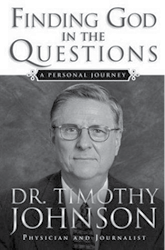
Recently a good friend called me to tell me that for the first time she was reading my book “Finding God in the Questions,” which was published 20 years ago (InterVarsity Press, 2004). She then issued this challenge: I should re-read the book now to see if my thinking has changed in the last 20 years. I have now done so and I am quite surprised to conclude that there is very little I would change.
However, I also remembered that the most difficult part of the book for me to write 20 years ago is still the most difficult issue for me to wrestle with today. Namely, the question “Is God in control?” Given the state of our world today, I would guess that it is a difficult question for any thinking religious person. So I am offering what I said then to see how it reads today for you.
In the summer of 1968, between my junior and senior years in medical school, Nancy (a nurse) and I worked in a small rural hospital in the village of Tomohon, in the northernmost tip of Indonesia. We went through a fellowship program, then administered by the Association of American Medical Colleges, designed to expose American medical students to dire medical needs in rural foreign settings. We had to arrange for an American doctor to serve as our sponsor, and we went to Indonesia because we knew a (Covenant) medical missionary, Dr. Philip Anderson, working in that location.
While driving us into the mountain village of Tomohon for the first time, Dr. Anderson joked that he had a little Indonesian child picked out for us. We laughed because nothing could have been more improbable; I faced several more years of training, and we were neither emotionally nor financially ready to start a family.
I soon met the little eighteen-month-old boy Dr. Anderson had in mind, because he was still in the “pediatric ward” (meaning wooden slats on a cement floor) after being left at the hospital by a “family friend.” He had some minor problems that needed attention but was basically in good health. After several weeks of getting to know him during my hospital work, I impulsively decided to take him with me to a birthday party for one of the Indonesian nurses. Nancy had been working in another part of the hospital, so that evening she met him for the first time. After the party we decided to take the toddler back to our quarters and give him a bath…. When the time came for him to go back to the hospital, we decided he should at least spend the night with us; I would take him back with me in the morning. We had a wonderful evening playing with him.
The next morning over breakfast, we looked at each other and immediately decided we should adopt this totally lovable young boy so he wouldn’t have to go into the orphanage when he was released from the hospital. From that moment on he was our son just as surely as if he had been born to us….
Does God cause good things to happen?
I tell this story to raise the very complicated and profound question of whether or not it’s possible and wise to believe in “providence” — the idea that the God responsible for the creation of this universe might also “arrange” or “direct” human affairs in everyday ways. In this context, is there any reason to believe that somehow God “arranged” that we would meet and adopt Nolden?
In retrospect it’s often startling to see how events in our lives that at the time appeared to be totally disconnected seem to have stunning — even spooky — connections. For example, in the case of our son’s adoption, Nancy and I could conceivably trace a line from the seemingly chance events of being raised in the same church denomination (though geographically separated by a thousand miles), meeting in Chicago because of that connection (she in nurses’ training at the hospital sponsored by our church, I attending their seminary), falling in love and getting married, my surprising decision to attend medical school, which led to the fellowship program, placing us in Indonesia because we knew a doctor who would sponsor us, arriving just at the time Nolden had been abandoned at the hospital. What a stretch, you might say! And I would agree, from the point of view that sees all of life as a series of entirely accidental and unrelated events. But what about a perspective that views life as a series of choices which, when made according to a set of principles based on maximizing the love of God and neighbor, may over time increase the possibility of ending up with a more fulfilling life? … But as I look back on my own life and choices, I can discern that kind of providential principle in my life and in the lives of others I know well. Put another way, the many individual choices we make along the way start to build up in a collective direction that can ultimately make a dramatic difference, depending on those individual choices.
I should make clear that I am not suggesting something as rigid or simplistic as “if I had not met Nancy my life would have been doomed,” or “if we had not gone to Indonesia, Nolden’s life would have been ruined.” I believe that there are many opportunities for all of us to make good choices, and if one does not work out, another will come along. Nor do I mean to suggest that even if we attempt to make good choices, everything will turn out ok. Life is too full of freedom and mystery for that guarantee. But I am trying to say that over a lifetime, if we make choices according to standards suggested by the Sermon on the Mount, we at least increase our potential for experiencing personal contentment, of being blessed.
And if that kind of “probability pattern” is built into the fabric of human affairs, in which different choices have different consequences, might we not legitimately call it “providence” and see it as part of God’s creative design? I readily admit this concept is not the kind of providence that many religious people adhere to — that is, God constantly directing the detailed traffic of everyday human affairs. But for me this “providence of probability” makes much more sense because it acknowledges the very real freedom — permitting free choice, but with consequences — we humans are allowed by the creator God. In other words I believe God has designed our world in a way that allows us to become partners with God in helping to determine the outcomes of our lives. We are not puppets at the ends of cosmic strings attached to the fingers of God. Rather we are like athletes, in this case entered in the race of life itself, who must make choices about how to use (or abuse) those gifts and opportunities we have been given.
Put another way, when we make important life choices based on purely selfish considerations, we eventually find ourselves “rewarded” for such choices. As C. S. Lewis put it in “The Great Divorce,” “There are only two kinds of people in the end: those who say to God, ‘Thy will be done,’ and those to whom God says, in the end, ‘Thy will be done.’” Even though there may be no immediate consequence of each individual choice we make, there will be an ultimate and cumulative effect from the many choices we make in our lives. We may be rich and famous but unhappy and unfulfilled precisely because we have ended up with what we have been choosing. Similarly, when we make choices according to the “will of God” — which, according to Jesus, means to love God and our neighbors as ourselves — we are more likely to end up with fewer material rewards but considerably more personal satisfaction and contentment. Because I believe these consequences are built into the way God created this world, I call them “providential” — intended by God but resulting from our free choices.
However, any concept of providence can be distorted. For example, what are we to make of the many wartime claims that “God is on our side”? We have heard such claims from both sides in most past wars, and we hear them today about conflicts in the Middle East. Sometimes it seems obvious that there is a specific evil — or a specifically evil person — that needs to be confronted and eliminated. For example, very few people would argue today about the necessity of removing Hitler and his cohorts from power on the world stage. But even when the legitimacy of war seems clear, I cringe at the religious language so often used to justify the actual destruction and killing — namely, that it’s God’s will.
Jesus reveals a God who weeps over the loss of life, even when justified by earthly necessity, because it represents a failure of the gift of free choice. In other words, war is always a failure of some humans to choose life over death, to choose love over hatred, to choose inclusion over exclusion. Although I believe war sometimes becomes necessary to correct the results of our human sinfulness, I can’t believe it is ever God’s hope for humankind.
And I become particularly upset when I hear people talk about the safe return of loved ones from war as the result of God’s direct action that by implication resulted in the death of others. During World War II a popular book came out titled “God Is My Co-pilot.” Commenting on that idea in the context of his 35 combat missions in a B-24 during WWII, George McGovern…wrote, “I give thanks to God for our survival, but somehow I could never quite picture God sitting at the controls of a bomber or squinting through a bombsight deciding which of his creatures should survive and which should die. It did not simplify matters theologically when Sam Adams, my navigator — and easily the godliest man on my ten member crew — was killed in action early in the war. He was planning to become a clergyman at war’s end.”
At an utterly trivial level by contrast, I also cringe when I hear God’s name invoked as the author of victory on the athletic field, implying that God arranged the defeat of the opponent; or I hear God invoked as the author of victory in business competition, once again implying that God is the reason for someone else’s loss. My reading of the Gospels suggests that God wants all his creatures to “win” in terms of life fulfillment and no one to “lose” in the game of life.
Why doesn’t God prevent bad things from happening?
When I was a child, both the starry heaven above and the Bible stories my mother read to me seemed to convey a very simple and consistent message: God, the Creator of the entire universe, loved me, little Timmy Johnson in Rockford, Illinois. Not only that but this God had provided me with all the blessings around me: loving parents, a safe home, food and clothing, friends to play with, trips to take to nearby lakes and parks. Believe it or not, and I am truly embarrassed now to admit this, it really wasn’t until I went to college in the big city of Chicago that I began to understand more fully that life wasn’t quite that simple or lovely for many people, maybe even most people. The questions about suffering and inequities and actual evil started coming at me — first from books and then from real life. When I became a medical student, I began to see life truly in the raw, both physically and emotionally. How could I still believe in the God of my childhood, the One who provides for our every need, when there was such horrible suffering in the world?
Let’s readily admit that much human suffering can be attributed to the immoral choices made by individuals, organizations and authority structures such as governments. But that still leaves an enormous amount of suffering that cannot be so explained: natural disasters and tragic diseases beyond our control. This issue is usually referred to as the problem of “undeserved suffering,” which we confront in trying to reconcile belief in a loving and just Creator with the terrible events in human life that do not result from the consequences of human choice. Why wouldn’t such a God prevent meaningless, cruel and evil events from taking place? The conventional religious explanation for this kind of suffering is that it is the “price we must pay” for the greater benefit of the true freedom in the universe allowed by God, a freedom that must also pervade nature if it is to be total freedom.…
However, even though I can’t articulate a fully satisfying answer to this age-old question, I can insist that there might be an answer. Just because no one who has taken on this question has come up with a fully satisfactory answer doesn’t mean there isn’t one. It is similar to the conundrum we encounter in studying the physical universe: just because we cannot explain it all doesn’t mean there isn’t an explanation. So it is also, I think, with the “moral universe.”
At this point I will describe what is for me the most helpful way to approach this terrible dilemma — namely, the age-old exercise of trying to “play God” and come up with an alternative to the world we now have. Though it sounds arrogant even to suggest alternatives to the universe as is, it’s only fair to try if I am willing to complain about the present one. But every time I try to do so, I end up admitting that I can’t imagine a world any different than the one we know. Certainly, when I contemplate the unimaginable sufferings of so many in our world, I would readily vote for a world without any suffering. Yet when I think more logically rather than simply voting with my heart, I find such a possible world less appealing than it first might appear. For example, imagining a world with neither suffering nor death (the ultimate cause of human uncertainty and anxiety) also conjures up a world in which humans would be incredibly smug, pursuing life without worry or concern.
So I find myself torn between the natural desire for a world without suffering, where we would feast forever on a cosmic silver platter, and the present one, where there is at least the possibility of striving to overcome pain and suffering with honest love and real choice. Does this mean that I can conclude — with some previous thinkers on this subject — that even with all its problems, this world is, after all is said and done, the “best of all possible worlds”? No, that is not what I mean or conclude. It may indeed be the best of all possible worlds that I can imagine with my limitations as a human being. But I would hope that the God who (I believe) created his universe has a bigger and better plan in mind than what I see so far.
In other words, if I can’t believe there is more to the created universe than what I now perceive in this journey we call human life, then I am the first to admit my disappointment with the “plan of God” as I have been exposed to it thus far. Put another way, if I can’t believe in some future existence beyond the earthly journey we experience from birth to death, then I must reluctantly conclude that God did not get it right, at least this time. Put still another way, the present world of earthly existence is at times so unfair — and there is simply no other way to describe the suffering of innocent human beings and even innocent animals— that it cries out for ultimate justice. And if that does not happen in this earthly existence — which it clearly does not in too many cases — then I believe it must happen in some future time if there is a God of justice and love, which is the only kind of God I care to believe in.