
A Note from the Diaspora
Scattered across the country and, for that matter, the globe are Pietists who await each issue of your journal for news from Minneapolis or Chicago, knowing that these are the places where Pietism really flourishes. But once in a while some incident of moment really does occur in the provinces. Those of us who live there either make the requisite pilgrimages to the Holy Cities or wait, hoping for something to unfold where we are, recalling the dominical promise that “where two or three are gathered....”
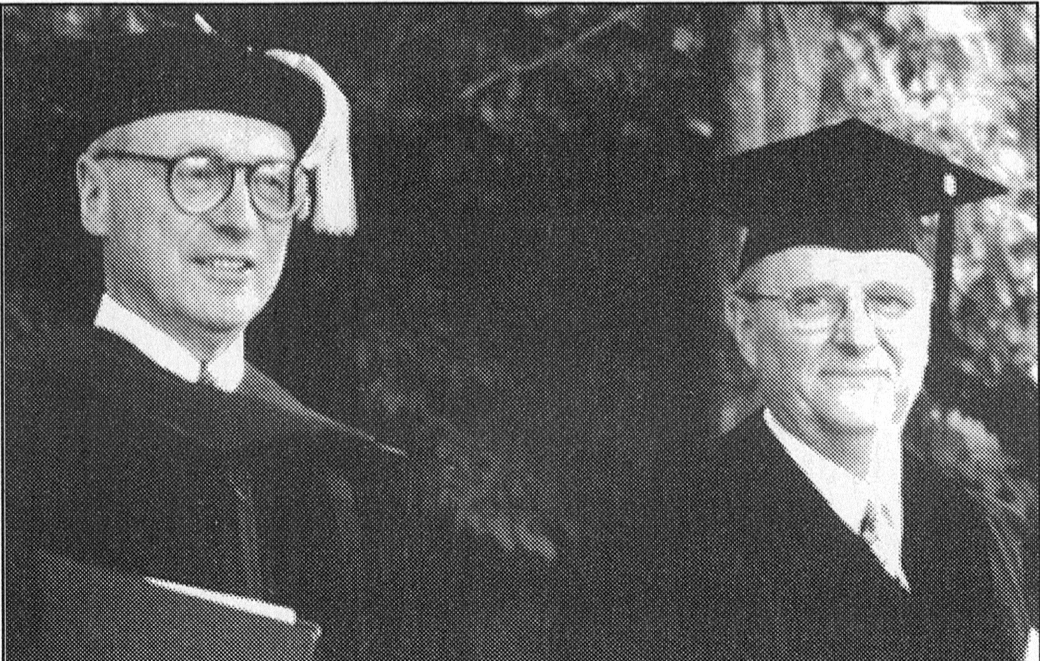
Such an unfolding did take place recently in, of all places, Rock Island, Illinois, two hundred miles from Chicago and four hundred from Minneapolis, when Drs. G. Timothy Johnson and James Lindblade drove to the fortieth anniversary of their graduation from Augustana College, there to be greeted by other North Park—Augustana hybrids from the fifties. Johnson had been invited to give the commencement address at the Swedish-American school and to receive an honorary doctorate in recognition of his achievements in medicine, the media, and the church.
The college chaplain, Richard A. Swanson, pronounced Johnson’s remarks the most memorable and moving graduation speech he had heard in twenty some years of invoking and benedicting at Augustana convocations.
Swanson, himself raised in the bosom of Lutheran orthodoxy and possessed of flawless credentials when it comes to doctrinal rectitude, was, as were literally thousands at the ceremony, deeply affected by the speaker’s avowal that though he had been trained as, and continues to be, a man of science, he believes that ultimately, in the most important moments and questions of life, one must listen to the heart. Johnson mentioned two instances from his own life when, acting against the brittle dictates of cold reason, he heeded that inner voice.
When serving as medical missionaries in Indonesia in the early sixties, Tim and his wife Nancy, a nurse, had under their care a year-and-a-half old orphan boy. His fate, had they not acted, was to return to the orphanage in which they found him. Without knowing how to get the boy back into the United States or what kinds of jobs they would find upon their return to America with which to support a family, the Johnsons adopted the child. He has grown to adulthood, married, found a profession, and been a life-long blessing to the couple who listened to their hearts when they first found themselves unable to give him up.
Johnson also described the path by which he had become a “television doctor.” When finishing medical school, he found himself appalled by the stand of the American Medical Association against universal health care and, in spite of his youth and concern for his future in the profession, wrote to the A.M.A. voicing his objections. It was the person who replied to that letter from Johnson who later asked him to do a program on a Boston station, and that program led to his work with ABC on a national basis. One must listen to the heart said Dr. Johnson in conclusion, for “I believe it is the voice of God!”
The speech was, in fact, splendid. But Pietists love conventicles even more than ceremonies. The reunion of Lindblade, with years of distinguished service in private practice and teaching at the University of Wisconsin, Madison, and Johnson, with Rock Island friends, itself constituted a conventicle in its own right. If, as Luther believed and the Augustana Chaplain has long maintained, the real meaning of Scripture is in its stories and its Story, then the trading of news about marriage, children, work, and old and common friends; the recital of anecdotes and episodes, most of them now known by heart (these men are after all in their sixties) is itself a conventicle. Johnson is no mean raconteur, and Lindblade has, if anything, heightened his capacity to decorate and enliven the memories he shares with such wit and grace. So, the graduation of 1998 was, in addition to being a time of joy and hope for four hundred and fifty Bachelors of Art and their families and a day of farewell for students leaving and faculty remaining, a time of reunion for a small cell of aging Pietists in the Diaspora.