
A Tribute to Carolyn and Douglas Cedarleaf
On January 25th, people gathered at Community Covenant Church to celebrate the ministry of the Cedarleafs. Here is the text of Peter Sandstrom’s tribute on that occasion. — Ed.
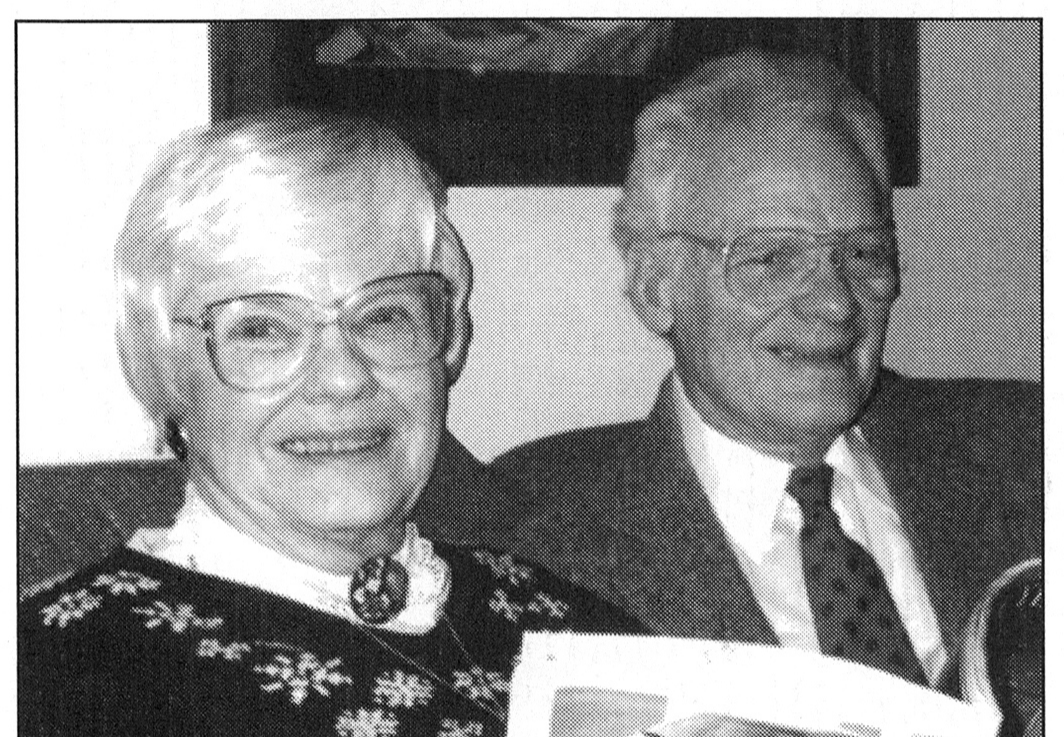
It is thirty-five years since our family moved from Sioux City, Iowa to the north side of Chicago. My father had been pastor of the First Covenant Church and we moved to Chicago where he became Director of Hi-League Work for the Covenant. Sioux City was a place where the big frame houses had backyards that seemed like forty-acre pastures—a child coming in from the alley for lunch could get lost trying to find his way to the back door. We moved into one of eight “missionary apartments” built of red or yellow brick on Christiana Avenue, where a child could injure his head on the garage just leaning out his back door.
After school each day of those long winter afternoons, I trudged the two blocks to this new apartment of ours mourning the loss of my Sioux City “state forest.” As I would walk by the endless rows of brick bungalows and two-flats (a tribute both to the Great Chicago Fire and to the Prairie School of Architecture), I would go by a brightly-colored, red and white, wood and brick house, with the most enormous picture window, almost from the ground to its eaves. As I walked by, I would usually see this woman standing in the window. Each time she waved to me! She seemed to know me! She had bright eyes and the rosiest cheeks I thought possible for an adult. It was Carolyn Cedarleaf who was probably waiting, in that bright red parsonage in which she raised four daughters and six foster children, for her two youngest daughters to come home from Peterson school which we all attended.
That wave to a grieving nine-year-old begin to lift me up out of anonymity. I had gone from being a well-known “P.K.” in a congregation of maybe one hundred and fifty, to an unknown “twerp” in a sanctuary that burst with five to seven hundred people. I had become one of the many. I was alone and I was sad and, let me tell you, each wave counted for something.
We were planted directly across the street from what seemed to be a slightly shrunken Medieval Gothic cathedral set in the midst of an urban Chicago neighborhood. I will never ever forget my first impressions of that sanctuary. Even now from that seat in the back row of the balcony, I can see the burning candles on the altar, the lofty wooden beams of the ceiling, the high arches down the sides of the sanctuary, the incredible ranks of pipes of the organ, the elaborately and ornately carved wood of the choir loft, and, rising behind the choir, the iridescent stained-glass of the chancel windows which I didn’t think it humanly possible to create.
In the middle of all this, in the center pulpit, was Doug Cedarleaf, perhaps the most intense and serious man I had ever seen! Even from a distance of two hundred feet—from the back to the front of that sanctuary—wearing a black Geneva gown (which I had never seen on a pastor before), and crowned with flowing, light, wavy hair, and the most furrowed brow I had encountered in my nine years, his most passionate voice carried all the way through to my hiding place in the balcony. I noted from my first Sunday that every last adult was intently focused on every word of that pastor.
During that time, Douglas Cedarleaf was pastor to a congregation that included the leadership of Covenant Headquarters, the faculty and staff of North Park College and Seminary, the craftsmen and trades people of the North Park community, laborers, wives, mothers, children, neighborhood people from several blocks away, and others. I never knew who I’d run into in the narthex.
Doug was also the pastor to the children. To this day, I mourn that so many of those sermons went flying right by me; I would give much to hear them again. But, though I didn’t understand his sermons as a boy (age 9 to 13), I did understand that something serious and significant was going on, that worship was taking place in that sanctuary.
Once or twice a year the cameras of WGN TV would come into our church, and beam the worship service to greater Chicagoland. And in my usual balcony perch, I sat behind a TV camera (in the pre-microchip age, the size of a refrigerator) and next to the cameraman. He would do his pan shots and obligatory close-ups. Then Pastor Doug would raise his voice and begin to preach the Word. I remember the cameraman setting the focus dial, stepping to the side, ignoring the monitor on his camera and the words which were probably ranting in his headset, and listening intently to Doug for twenty-five minutes.
Though I was young, dense, and naive, I can still recall some moments from those sermons. Only ten brief months after we arrived in Chicago, President John Kennedy was assassinated. Some of you were in the North Park sanctuary that day. People were shaking. Never before had I been aware of the idea and the experience of pastoral leadership in a crisis. Pastor Cedarleaf began to speak to the situation. Midway through his sermon, one of the ushers walked up to the pulpit and handed him a note. “What is this?” I thought. Then I saw Doug grab his head and begin to weep out loud. Hanging over the pulpit, he cried: “And NOW, THEY’VE KILLED OSWALD!” Thunder went through the sanctuary. Then Pastor Cedarleaf took us through our congregational grief, not sweeping anything under the carpet, but putting our grief before the altar of God.
During the Sunday of Passover Week, a couple of years later, he told us this story. He was walking through the North Park neighborhood on Passover Night when an elderly Jewish man invited him into his home. Invite is an understatement. The man put his arm around Doug’s neck and shoulder and virtually dragged him in to celebrate the Passover meal. They wanted twelve around their table and there were only eleven. They found Doug, and he looked “twelvish.” He went in and started to celebrate the beginnings of Passover with them. When they came to the moment for sharing the ceremonial cup of wine, it came to him, he told us—I’ll never forget those words spoken from that pulpit—“Wine had never touched my lips and I was Pastor of the North Park Covenant Church.” Good News came to him. The Word of Torah came through and he was allowed in that moment to take the cup and to celebrate God’s graciousness to the Jewish People and to celebrate Passover for the first time in his life.
What a liberating word this was for me! I attended a school that was ninety percent Jewish and this gave me the license and liberty to perceive the integrity of my friendships with my Jewish classmates, to respect their religion, to acknowledge their Faith, and to see my own part in it. My friends had worth and I could set aside any need to see them as objects for evangelism.
On the last Easter Sunday morning before my voice changed, wearing a white robe, sitting in the front row surrounded by more adult choral voices than I could count and the sounds of a full pipe organ, I sang as a boy soprano. “Ockie” Olson led us as we sang “The Holy City.” An eleven-year-old, I could reach that high note near the end and I really did. We continued to stand as Pastor Doug went to the pulpit to say with passion, almost weeping as he spoke: “They came to the tomb and HE WAS RISEN!” This was how I came to learn the Gospel as a grade school student. This was my Covenant boyhood.
Doug was the pastor to many confirmands. On Confirmation Sundays, I would watch what seemed a veritable sea of thirteen- and fourteen-year-olds up front. I am neither exaggerating nor distorting the truth when I report that the confirmation class stood the whole time (this confirmation service was not cutesy nor primarily for family pictures, but sacramental in every sense of the word) and read not only the whole catechism but also recited the entire Sermon on the Mount. That’s right—the entire Sermon on the Mount! It takes up three whole chapters in the Gospel of Matthew! When they came to the Lord’s Prayer portion of the sermon, each child’s head went down on cue and they prayed that prayer for us. After the prayer, they lifted their heads and completed the rest of the Sermon. That’s what loomed before me as a pre-confirmation boy! Perhaps there was some kind of grace in moving to Rockford, Illinois when I was thirteen. But, when I went through confirmation there, even though I received some nice words about my essay, I knew I had not really delivered. I hadn’t memorized The Sermon on the Mount.
Doug was formidable and I was in awe of him. I tried to keep my distance from that brow. As my father and I were making our way down the center aisle of the sanctuary one Sunday morning after worship, I saw Pastor Cedarleaf come down the side aisle under one of those arches. “Hey, Bill!” My father answered: “Yes, Doug!” Bill? Doug? Doug was smiling and they were joking. I wondered what they were saying, but I didn’t want go near enough to hear them—too many strange things had happened in the span of five seconds.
This same formidable person led, or attempting to lead, family devotions around the dining room table. Imagine being within two-to-six feet of that kind of power! But I heard from one of the four Cedarleaf daughters that the girls would silently mouth words to communicate among themselves while formidable Doug led devotions. As Pastor-Father glanced down at the text, the girls passed notes under the tablecloth. Sometimes someone broke out in massive giggles. Mother Carolyn might have done something about it except that she was often a participant and, if truth be out, occasionally one of the instigators! All the Cedarleaf daughters were known for their good cheer, for their fun, for their spontaneity, and for their warmth. Carolyn’s gift.
I became a Junior Hi-Leaguer my last year at North Park Covenant. After a tobogganing party, we were invited into the Cedarleaf home for some hot chocolate. The scene is set forever in my brain: As we walked in, I took off my coat and hat and was about to introduce myself to Carolyn. I said: “Hi, you don’t know me but I’m...” “Oh, Peter, I am so glad you’re here.” I can still see the lighting and wall paper behind her face. I was stunned; she knew my name. My name was known, recognized, and spoken out loud!
The previous year, I was operated on at Swedish Covenant Hospital. Doug came to visit me—not during normal parental visiting hours so as to impress my parents. He came to see me. I can’t quite get over his coming into that room, standing by my bed, reading Scripture, and praying that day.
My last spring, three of us Junior Hi-Leaguers went with Doug to visit shut-ins for Lenten home communion services. Our role was to read scripture and sing. On the last visit, he turned to me and said: “Do you want to share in communion today?” In my household I had heard that only confirmands were able to do that. He looked at me and said: “You can. You don’t have to wait for confirmation.” I was so surprised that I just couldn’t say yes though I wanted to. Nonetheless, it was a sacramental time for me because for the first time I was given the option of participating as an adult in the Lord’s Supper. I was given both the honor of choosing as well as respect for my opinion. These blessings are given to young people at their rite of passage. In a deep sense, Doug confirmed me that day. After that, I began to consider myself an adult, Christian decision-maker.
About seven or eight years ago, shortly after Doug and Carolyn moved to the Twin Cities, I preached for Jim Sundholm at Community Covenant Church. It was a summer Sunday. I came into the sanctuary a bit early and recognized some people from the back: Daisy Goines, Bertha Cornelius, Ma Rogers, and Ellen Gustafson. I knew, in light of all that they had gone through just to get there, that I had to deliver that day. I couldn’t fail them. So, I feverishly went over my notes one more time as I usually do and I wondered about the order of worship and details of the service. Suddenly, I glanced up and saw to my horror Barbara and Zenos Hawkinson. Zenos Hawkinson, my history professor from North Park, was here! Suddenly I became a lowly seventeen year-old college freshman again sitting in the back row of the lecture hall during “Soc. Sci. 101!” As I thought to myself: “It just can’t get any worse than this,” I looked to the side of the sanctuary and saw Doug and Carolyn Cedarleaf, my old pastor and his wife! Now, just as suddenly, I felt like that ten-year-old boy up in the balcony of North Park Covenant Church. It is hard to be nearly forty and seventeen and ten-years-old all at the same time—but there I was.
Afterward, I found myself in the narthex with Doug and Carolyn a few feet from me. I gathered my courage, approached them, and said: “Hello, Cedarleafs. You probably don’t remember me but I was a boy at North...” “Oh, Peter, it is so good to see you again!” Carolyn broke in. “We so enjoyed you and your family when we were all at North Park!” The moment is frozen in time. Someone significant, whom I had not seen since I was a boy more than twenty-five years earlier, remembered me and knew me. Pastor Doug even said a couple of nice things about my sermon and offered his own commentary on the text.
Doug and Carolyn, you embody the Covenant of my boyhood, a Covenant in which people were recognized, their names known and spoken aloud, and in which they had a place. It was a time when integrity of worship and impassioned interpretation of the Word were valued more than entertainment and chattiness. The sacrament, beauty, and reverence were instilled in us as children through your ministry. We are grateful that you both continue to bless us with your presence and spirit.