
Black Giants of the Sacred Harp
In the early to mid-1700s, during the first American revival movement known as the “Great Awakening,” a new kind of worshiping-through-song developed. There were few musical instruments to accompany singers in Colonial America, and the singers paid little attention to either timing or pitch. In order to improve religious singing, the churches developed singing schools. Through the experience gained from teaching in these schools, the shape-note system was invented. The shaped notes made it possible for untrained, unaccompanied voices to follow musical lines and to harmonize without the use of musical instruments. Time was kept by enthusiastic pounding of the feet.
During the 1800s as pianos, organs, and other instruments became more prevalent in churches, shape-note singing all but died out except in the rural South. There, the publishing of the B. F. White shape-note songbook seemed to hold the movement together. The White book had four shapes of notes, to represent Fa, Sol, La, and Mi, and four harmonic parts, bass, tenor, alto, and treble. The movement remained especially strong in Alabama, Georgia, and Florida.
In Alabama during the first few years of the 1900s, two new shape-note songbooks were published: The Cooper book and the Denson book. The Cooper book pretty well covered the market in south Alabama and north Florida, whereas the Denson book covered the market in north Alabama and Georgia. Both of these new books were based on the old B. F. White songbook of the 1830s, but their new songs pumped life into the shape-note singing tradition.
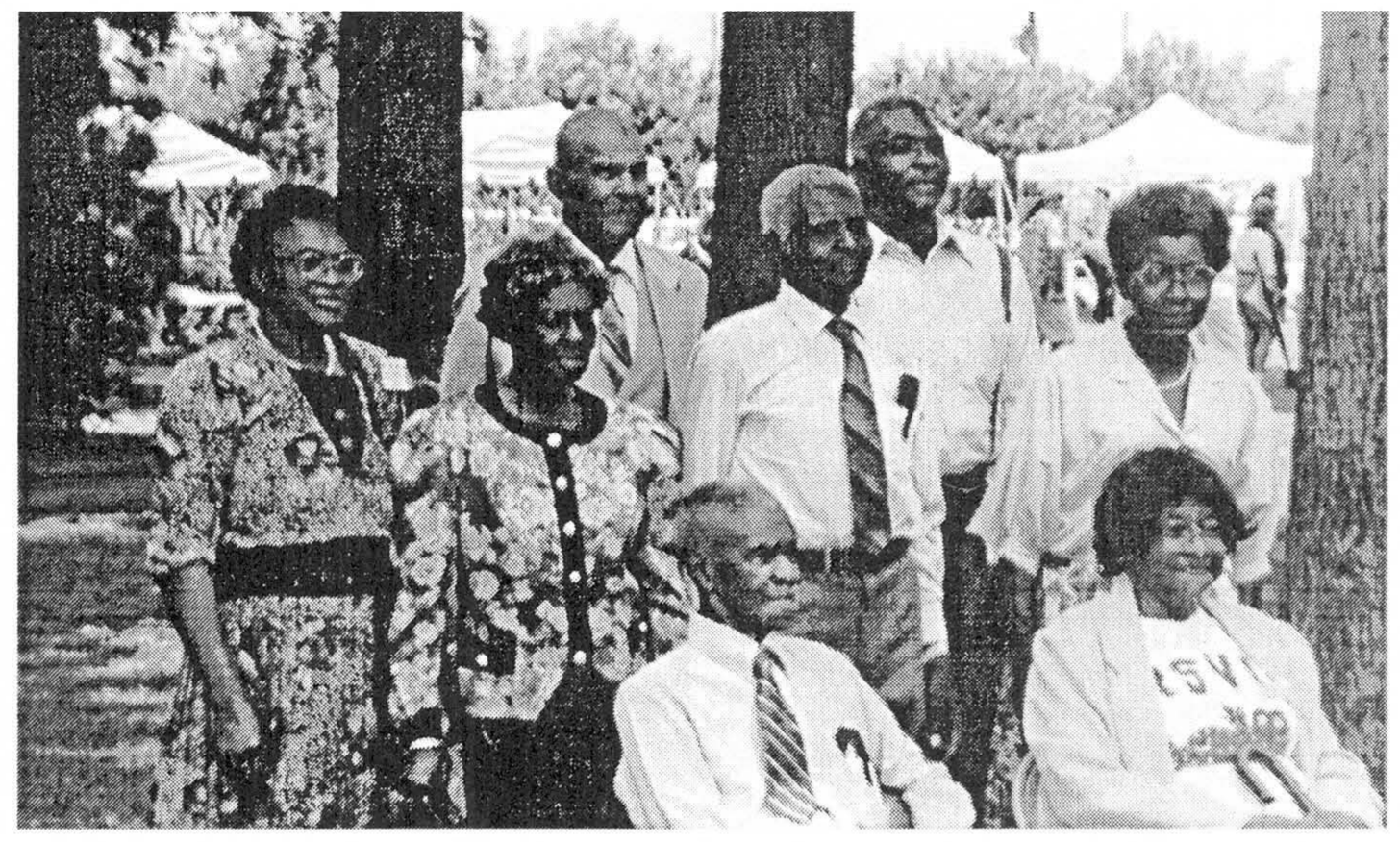
The Wiregrass Sacred Harp Singers (Henry Japheth Jackson is the man farthest to the right.)
The movement had by then become known as the Sacred Harp — from the idea that the human voice is a God-given instrument, the Sacred Harp. Sacred Harp songs are natural songs, composed by people who are, themselves, singers within the tradition. Sacred Harp takes very little from European religious music, other than its structure. Writers in American music history describe Sacred Harp as being “white gospel music.” As each new edition of a Sacred Harp songbook comes out, new songs are added and old songs, no longer sung, are dropped. A good example of some of the newer songs is the popular “Florida Storm,” based on a real happening when people, black and white, gathered together during a Florida hurricane and prayed for God to save them from the terrible storm.
Black people began singing Sacred Harp around 1889, and a strong tradition developed among rural black people living in the triangle formed of southwest Georgia, southeast Alabama, and northwest Florida. A young black man named Judge Jackson began singing Sacred Harp in Alabama around 1900 and soon became a major force in black Sacred Harp. He composed his first Sacred Harp song in 1904.
Judge Jackson brought one of his songs to the publishers of the Cooper Sacred Harp songbook in Dothan, Alabama around 1924 and asked them to include it. He was turned down. It was then that he determined to publish a Sacred Harp song book himself — a book of songs composed only by black people. It was not until 1934, however, that Judge Jackson was able to accumulate the funds to publish the first soft-bound edition of The Colored Sacred Harp, an all new Sacred Harp songbook with 77 songs composed by black Sacred Harp singers. The book included 17 of Judge Jackson’s own compositions. Today the book exists in a new, hard-bound edition and is known throughout the world. Judge Jackson’s songs have also been included in the new edition of the Cooper Sacred Harp songbook.
Judge Jackson died a number of years ago, but he is not forgotten. In addition to the continuation of his memory through the songbook, the federal housing project in his hometown, Ozark, Alabama is named for him. There is also a monument honoring him in the town. The black Sacred Harp tradition is being continued by his son, Henry Japheth Jackson, who now publishes The Colored Sacred Harp and is also president of the Alabama and Florida Sacred Harp Convention. Both Jacksons, father and son, have achieved world recognition in folk music circles.
Not long ago, I had the opportunity to spend an afternoon with the son, Henry Japheth Jackson. Mr. Jackson is a tall man who stands very straight despite a slight limp. I would have taken him to be 15 years younger than the 78 years he told me he has lived. We sat across from each other drinking coffee in his living room as he reminisced about his father and about Sacred Harp.
“When I was a child, I was going to those singings and camp meetings all over with my father, and it never once entered my mind that I would one day be president of the Alabama and Florida Sacred Harp Convention. I grew up in Sacred Harp. My father believed in it. He used to say that anyone who sang Sacred Harp would never go to jail. But the grown folks kept us children on the side. They didn’t think our voices were strong enough to do much singing. Now, I would be glad to have a strong-singing 14-year-old right on the front row.
“There were lots of young people at those singings. They got to meet each other. Many marriages came out of the meetings. We would start out really early in the morning in our buggy pulled by a mule — our father never owned a horse. Sometimes it would take us all day to get where they were holding the Sacred Harp singing and camp meeting. When we arrived at the church, the yard all around it would be full of people. There were so many people they couldn’t even begin to get inside the church building. Stands were set up in the yard on both sides of the church selling soft drinks in dry ice — that was the first time I ever saw dry ice. I thought it was the most amazing stuff I had ever come across. There was lots of food at those stands, too.
“I was the ninth of twelve children. Almost every night we’d have supper at home, then sit around the house and sing Sacred Harp — there were plenty of us to do it, too. My father was a compelling man. When I was a boy, I thought everybody sang Sacred Harp like we did — everybody in the world, I guess. One time we got in our buggy and rode all the way to Jacksonville, Florida for something; I don’t remember what. That was the first time I had ever met anybody who had never sung, or even heard of, Sacred Harp.
“They wouldn’t publish my father’s song, ‘Alone,’ in the 1924 Cooper Sacred Harp book. They wouldn’t publish it, so he had to do it himself. If they had published it, I guess The Colored Sacred Harp never would have been.”
Mrs. Jackson walked into the room and refilled our coffee cups. She said, “I met Japheth at a singing school his father, Judge Jackson, held in our little community. After we were married, I quit singing. Since then I have been cooking for the singing meetings. Sacred Harp singers can eat a lot. During the last few years I haven’t been doing much cooking, though. Now, mostly, I get it catered.”
Henry Japheth Jackson was interviewed on Public Radio and Public Television. He appeared on a Bill Moyers special. He and the Wiregrass Sacred Harp Singers travelled all over the United States to universities and to historic and folk festivals. The Wiregrass Sacred Harp Singers also put on a demonstration at the Smithsonian Institution in Washington, D. C. Mr. Jackson received the “Certificate of Appreciation” from the Smithsonian. He was also selected to be included in the International Who’s Who of Music and received the “Achievement Award” from them in 1974.
It was late in the afternoon when I left their house. Mr. and Mrs. Jackson followed me onto the front walk under the trees that shaded their front yard. “I believe there’s a scripture which says something about all things working for the best in the way of the Lord,” Mr. Jackson said. I smiled at them as I drove away. They smiled back at me. In my mind I could see the giant shadow of Judge Jackson standing behind them.